Abstract
This study provides a comprehensive, quantitative forecast of the dynamic impact of the European Union Deforestation Regulation (EUDR) on forest product exports from nine major Asia-Pacific economies to the EU market. To address the complexity of this policy shock, we develop a novel two-stage forecasting framework that integrates LASSO regression for high-dimensional variable selection with OLS modeling. This approach generates dynamic monthly projections from October 2025 to December 2027, simulating the policy’s effect by combining a historical proxy from the European Union Timber Regulation (EUTR) with a calibrated “intensity multiplier” based on the EUDR country-risk classification. Our projections reveal a distinct multi-phase adjustment process across the region: an immediate, sharp contraction in Q4 2025, followed by a period of significant volatility and supply chain disruption throughout 2026, and an uneven recovery in 2027. The findings underscore substantial heterogeneity in impacts driven by the EUDR risk-based framework. Standard-risk countries, such as Indonesia and Malaysia, are projected to face severe volatility and suppressed growth trajectories, with Malaysia’s exports showing particular vulnerability. In contrast, some smaller, low-risk nations like the Philippines may capitalize on a substitution effect, gaining market share as larger suppliers struggle with compliance. The study concludes that the EUDR acts as a powerful disruptive force, reshaping competitive dynamics and necessitating urgent policy responses, including enhanced traceability infrastructure and strategic market diversification, for Asia-Pacific exporters.
Keywords
EU Deforestation Regulation (EUDR), Forest Product Trade, Asia-Pacific, Time-series Forecasting, LASSO
1. Introduction
Forests, spanning over four billion hectares and covering 31% of the Earth’s terrestrial surface, constitute a critical global commons. They are indispensable for climate stability, biodiversity conservation, and the livelihoods of billions. However, this vital ecosystem is under severe threat, with an estimated 10 million hectares of forest lost annually, primarily driven by agricultural expansion and illegal logging. This persistent deforestation not only undermines global environmental goals but also jeopardizes the long-term viability of forest-based economies.
In response, major consumer markets have moved to eliminate deforestation from their supply chains. The European Union, a pivotal actor, first enacted the European Union Timber Regulation (EUTR) in 2013. While a pioneering step, the EUTR’s narrow focus on “legality” and its challenges-including inconsistent enforcement and difficulties in verifying timber origin-limited its overall effectiveness. Its failure to fully stem the flow of high-risk timber into the EU market necessitated a more robust legislative framework, culminating in the adoption of the European Union Deforestation Regulation (EUDR) in 2023. The EUDR represents a fundamental paradigm shift from a legality-based to a sustainability-centered approach.
The EUDR dramatically expands the regulatory landscape. It broadens the scope beyond timber to include key deforestation-risk commodities like cattle, cocoa, coffee, palm oil, rubber, and soy. Crucially, it mandates stringent due diligence, requiring operators to provide precise geolocation data for the plots of land where their commodities were produced to prove no deforestation occurred after December 31, 2020. This enhanced traceability requirement, coupled with the elimination of automatic exemptions for certified products and strengthened penalties, closes critical loopholes that undermined its predecessor.
This regulatory evolution holds profound implications for the Asia-Pacific region, a strategic nexus in the global forest product trade. The region features a deeply integrated supply chain: resource-rich nations like Indonesia and Malaysia are vital suppliers of raw materials, while manufacturing powerhouses like China and Vietnam transform them into high-value finished products. The EU serves as a critical end-market for this ecosystem. For instance, China-EU trade in wood forest products consistently exceeds $16 billion annually, underscoring a deep interdependence. Within this complex network, the EUDR acts as a disruptive force. Its stringent traceability and compliance demands pose a direct challenge to the region’s numerous smallholders and small and medium enterprises (SMEs), who often lack the technical and financial capacity to adapt, thereby risking their exclusion from EU-bound supply chains and potentially distorting established regional trade flows.
Despite the urgent and transformative nature of this policy, the current academic discourse remains predominantly qualitative. While existing studies adeptly outline strategic challenges and potential socio-economic consequences, there is a critical scarcity of systematic, quantitative assessments capable of forecasting the EUDR’s dynamic impact on trade volumes and patterns. This study seeks to address this pressing research gap. By developing a novel forecasting model, our research aims to move beyond conceptual analysis and provide data-driven, empirical insights into the regulation's effects on Asia-Pacific forest product trade. The ultimate objective is to equip policymakers, industry associations, and businesses with actionable intelligence, enabling evidence-based strategic adaptation in the face of this transformative global policy.
2. Literature
The existing research on the implications of the EUTR and its successor, the EUDR, for Asia-Pacific forest product trade is predominantly qualitative, with a pronounced scarcity of quantitative impact assessments.
Early analyses of the EUTR largely focused on its strategic and operational implications. Yin et al. (2011)
| [1] | Yin, Z. H., Li, J. Q., Tian, H., et al. (2011). Impacts of EU Timber Regulation on international trade of forest products and China's countermeasures. Research of Agricultural Modernization, 32(5), 537-541. https://doi.org/10.3969/j.issn.1000-0275.2011.05.006 |
[1]
and Hou et al. (2013)
argued that while the regulation erected short-term market access barriers, it would ultimately promote sustainable forest management and enhance the competitiveness of verified legal timber. Subsequent research, such as by Hou and Zhuang (2015)
, identified adverse effects on specific export sectors, notably China's wooden furniture industry. Scholars like Brack (2017)
contextualized the EUTR within the broader global effort to combat illegal logging, noting its role in shifting due diligence burdens onto the private sector, a theme that has profoundly evolved under the EUDR.
The academic focus has now decisively shifted to the more stringent EUDR. Recent qualitative studies consistently highlight its unprecedented challenges. Mao et al. (2022)
emphasized its direct impact on commodities like rubber and timber, urging a significant strengthening of due diligence systems. From an international perspective, Simonnet (2023)
and Permatasari et al. (2024)
warned that the EUDR’s high compliance costs, particularly for geolocation tracing, risk excluding smallholders in Southeast Asia from formal supply chains. This could inadvertently divert trade to markets with lower environmental standards, a phenomenon known as “leakage”, which paradoxically might exacerbate deforestation risks globally (Jopke & Schoneveld, 2022)
. Furthermore, studies on specific commodities, such as those by Roldan et al. (2025)
| [9] | Roldan Muradian, Raras Cahyafitri, Tomaso Ferrando, Carolina Grottera, Luiz Jardim-Wanderley, Torsten Krause, Nanang I. Kurniawan, Lasse Loft, Tadzkia Nurshafira, Debie Prabawati-Suwito, Diaz Prasongko, Paula A. Sanchez-Garcia, Barbara Schröter, Diana Vela-Almeida. Will the EU deforestation-free products regulation (EUDR) reduce tropical forest loss? Insights from three producer countries. Ecological Economics. 225(227): 108389.
https://doi.org/10.1016/j.ecolecon.2024.108389 |
[9]
on palm oil, illustrate the complex governance challenges and potential for trade disruption the regulation introduces for producer countries.
In parallel, a well-established stream of quantitative research on international forest product trade has extensively employed the gravity model, pioneered by Anderson (1979)
. This framework has been robustly applied to demonstrate the correlation between economic mass and wood product exports (Larson et al., 2018)
| [11] | Larson, J.; Baker, J.; Latta, G.; Ohrel, S.; Wade, C. Modeling International Trade of Forest Products: Application of PPML to a Gravity Model of Trade. Forest Products Journal 2018, 68, 303-316. https://doi.org/10.13073/fpj-d-17-00057 |
[11]
and to analyze the determinants of China's forest trade flows (Nasrullah et al., 2020)
| [12] | Nasrullah, M.; Chang, L.; Khan, K.; Rizwanullah, M.; Zulfiqar, F.; Ishfaq, M. Determinants of forest product group trade by gravity model approach: A case study of China. Forest Policy and Economics 2020, 113, 102117.
https://doi.org/10.1016/j.forpol.2020.102117 |
[12]
Extensions of this model have incorporated factors like regulatory distance and certification to assess non-tariff barriers, providing a methodological foundation for analyzing policy impacts.
In summary, a clear research gap persists between rich qualitative studies that outline strategic challenges and established quantitative models that have not yet been systematically applied to forecast the EUDR’s dynamic, forward-looking impacts. A key exception is the recent work by Xu et al. (2025)
, who employed a Computable General Equilibrium (CGE) model to simulate the EUDR’s effects, providing a crucial quantitative benchmark. However, the reliance on CGE models, with their inherent dependence on theoretical assumptions and static baseline scenarios, underscores the need for complementary, data-driven forecasting approaches.
This study aims to contribute to bridging this gap by integrating machine learning techniques to handle complex, high-dimensional predictors and by employing time-series models to project the dynamic, month-by-month impact of the EUDR on key Asia-Pacific economies. This methodology offers a flexible and empirically grounded pathway for assessing the policy's multifaceted consequences, complementing existing structural models.
3. Data
3.1. Dependent Variable: Forest Product Trade Data
This study projects the dynamic trajectory of wood forest product exports (HS code 44) from nine key Asia-Pacific economies to the European Union following the implementation of the EUDR. The forecasting period extends from October 2025 to December 2027, capturing the critical initial phase of the regulation’s full implementation. The selected countries-Thailand, Malaysia, Vietnam, Indonesia, New Zealand, Singapore, Korea, Japan, and the Philippines-represent a diverse cross-section of the region’s forestry export profiles. China is deliberately excluded from this analysis, as its specific circumstances have been thoroughly investigated in prior research, including the recent working paper by Hu et al. (2025)
| [14] | Hu, Y. H.; Meng, Q.; Xia, J.; Chen, N. Impact of EU Deforestation-free Regulation on China's forest products trade. Working paper 2025. |
[14]
, which provides a focused benchmark.
The empirical analysis is grounded in a balanced panel dataset comprising monthly export values of the relevant forest products from these nine countries to the EU, with observations spanning from January 2013 to April 2025. A noteworthy aspect of the data compilation involved standardizing monetary units: original export values for Thailand and Malaysia, reported in Thai baht and Malaysian ringgit respectively, were converted into U.S. dollars to maintain consistency across the sample. This harmonized dataset captures substantial heterogeneity in export volumes among the included economies, thereby offering a robust empirical foundation for evaluating the potential heterogeneous effects of the EUDR across different national contexts.
Table 1. Descriptive Statistics of Forest Product Exports to the European Union.
Country | Philippines | Japan | Korea | Singapore | New Zealand | Indonesia | Vietnam | Thailand | Malaysia |
Unit (Million) | USD | USD | USD | USD | USD | USD | USD | Thai Baht | Ringgit |
Mean | 0.5327 | 0.3470 | 0.5927 | 0.5842 | 3.3493 | 26.6307 | 62.7781 | 126.5784 | 54.7765 |
Median | 0.4502 | 0.3308 | 0.5400 | 0.5185 | 3.2502 | 26.7732 | 57.5779 | 120.1666 | 53.6988 |
Standard Deviation | 0.3490 | 0.1382 | 0.2265 | 0.4326 | 1.6299 | 5.7671 | 18.1886 | 52.0030 | 13.1694 |
Variance | 0.1218 | 0.0191 | 0.0513 | 0.1871 | 2.6566 | 33.2592 | 330.8267 | 2704.3084 | 173.4340 |
CV | 0.3490 | 0.1382 | 0.2265 | 0.4326 | 1.6299 | 5.7671 | 18.1886 | 52.0030 | 13.1694 |
Descriptive analysis of the historical data reveals significant heterogeneity in both export scale and stability across countries prior to the EUDR’s implementation. A clear hierarchical differentiation is evident in the pattern of exports to the EU. Vietnam and Indonesia emerge as the region’s dominant suppliers, with average monthly export values of approximately $62.78 million and $26.63 million, respectively, constituting the first tier. Malaysia ranks third, with average monthly exports of around $12.45 million. A smaller second tier is formed by New Zealand and Thailand, with monthly export values of approximately $3.35 million and $3.72 million², respectively. In stark contrast, the export volumes from Korea (approx. $0.59 million), Singapore (approx. $0.58 million), the Philippines (approx. $0.53 million), and Japan (approx. $0.35 million) are substantially smaller, with monthly averages well below $1 million, indicating a lower degree of trade dependency.
In summary, the region’s wood forest product exports to the EU exhibit a distinct multi-tiered structure. For export powerhouses like Vietnam and Indonesia, this trade is a vital component of their commerce with the EU, rendering them highly exposed to the compliance adjustments and potential economic shocks of the EUDR. Other nations, due to their smaller trade volumes or differing degrees of volatility, are likely to face challenges of varying types and magnitudes. This historical baseline provides a crucial, differentiated perspective for the subsequent predictive analysis.
3.2. Predictor Variables: Macroeconomic and Trade-related Indicators
To enable a robust projection of the EUDR’s potential effects, this study systematically assembled a high-dimensional dataset of 46 monthly country-level variables, structured around three theoretically-informed dimensions: the macroeconomic environment, trade and logistics costs, and market supply-demand conditions.
First, to represent the macroeconomic context, key indicators were incorporated, including the benchmark interest rate and domestic Consumer Price Index (CPI) of each exporting country, as well as its exchange rate against the euro and the EU’s Harmonized Index of Consumer Prices (HICP). These variables collectively gauge the influence of monetary policy, currency valuation shifts, and domestic versus destination-market inflationary pressures on trade flows.
Second, in alignment with established trade literature (e.g., Wang et al., 2019)
| [15] | Wang, F. T.; Liu, S. T.; Cheng, B. D.; Jiang, Q. E.; Tian, Y.; Xiong, L. C. How Can Intra Industry Trade of Forest Products be Promoted? An Empirical Analysis from China. Forests 2019, 10, 882. https://doi.org/10.3390/f10100882 |
[15]
, international crude oil prices were included as a core proxy for fluctuating transportation energy costs. This foundational measure was augmented with a container freight rate index for major global shipping routes, offering a more direct and comprehensive reflection of integrated logistics expenses, which encompass factors such as port handling efficiency and vessel capacity utilization.
Finally, to quantify underlying economic activity and final market demand, the model integrates the total monthly import and export values for both the exporting countries and the EU. These figures serve as effective indicators for aggregate national production capacity and the corresponding market absorption potential within the European bloc. All predictor data were primarily compiled from authoritative sources including the CEIC and China Economic Information Network databases, supplemented by official national customs statistics.
The variables underwent stationarity adjustments through three specific methods: (1)(2)(3) For index-type variables defined with the same period of the previous year as the base period (=100), method (1) was applied; otherwise, method (2) was used for transformation.
Table 2. Descriptive Statistics of Predictor Variables.
Variable Name | Unit | Resource | Mean | Median | Standard Deviation | Variance | CV |
EU 27 Furniture Import Volume | Billion EUR | CEIC | 1.43 | 1.36 | 0.43 | 0.18 | 0.43 |
EU Total Import Volume | Billion EUR | CEIC | 167.45 | 152.57 | 37.88 | 1435.25 | 37.88 |
China’s Export Volume of Wood Products for Household or Decoration Use (Month-over-Month Growth Rate) | % | CEIC | 0.00 | 0.00 | 0.56 | 0.31 | 0.56 |
EUR/RMB | EUR/RMB | CEIC | 7.65 | 7.72 | 0.41 | 0.17 | 0.41 |
USD/RMB | USD/RMB | CEIC | 6.66 | 6.69 | 0.36 | 0.13 | 0.36 |
China CPI | (2015=100) | CEIC | 107.28 | 107.70 | 6.64 | 44.07 | 6.64 |
Malaysia (Plywood & Veneer) Production Volume | Cubic Meters | Department of Statistics Malaysia | 315322.06 | 288486.50 | 79401.54 | 6304604414.15 | 79401.54 |
Malaysia Unemployment Rate | % | Department of Statistics Malaysia | 3.51 | 3.40 | 0.55 | 0.30 | 0.55 |
Malaysia’s Total Export Volume to the EU | Million Malaysian Ringgit | Department of Statistics Malaysia | 7498.27 | 7282.15 | 1868.68 | 3491976.12 | 1868.68 |
USD/MYR | USD/MYR | Central Bank of Malaysia | 4.08 | 4.17 | 0.45 | 0.20 | 0.45 |
Malaysia CPI | (2010=100) | Department of Statistics Malaysia | 120.45 | 120.80 | 7.79 | 60.63 | 7.79 |
Thailand CPI | (2023=100) | Office of Trade Policy and Strategy | 93.69 | 92.20 | 3.93 | 15.41 | 3.93 |
Thailand’s Total Export Volume to the EU | Million Thai Baht | Ministry of Commerce | 65899.07 | 65517.85 | 8822.00 | 77827752.84 | 8822.00 |
Thailand Loan Interest Rate | Annual Interest Rate % | Bank of Thailand | 21.27 | 22.11 | 1.28 | 1.63 | 1.28 |
USD/THB | USD/THB | Bank of Thailand | 33.23 | 33.07 | 1.93 | 3.71 | 1.93 |
USD/VND | USD/VND | State Bank of Vietnam | 22677.52 | 22947.50 | 1032.04 | 1065098.59 | 1032.04 |
Brent Crude Oil Price | USD/Barrel | CEIC | 72.49 | 72.32 | 22.84 | 521.69 | 22.84 |
HICP: Furniture, Household Equipment, and Routine Household Maintenance Price Index | (2015=100) | CEIC | 104.48 | 100.99 | 6.55 | 42.92 | 6.55 |
Euro Area Harmonised Index of Consumer Prices | % | CEIC | 2.01 | 1.57 | 1.21 | 1.47 | 1.21 |
Container Throughput Index: Asia: China | (2015=100) | CEIC | 117.46 | 115.81 | 18.98 | 360.25 | 18.98 |
Container Throughput Index: Northern Europe: Baltic Sea | (2015=100) | CEIC | 122.83 | 125.41 | 14.96 | 223.79 | 14.96 |
Container Throughput Index: Northern Europe: North Sea | (2015=100) | CEIC | 106.13 | 105.45 | 7.16 | 51.27 | 7.16 |
Container Throughput Index: Southern Europe | (2015=100) | CEIC | 113.74 | 116.76 | 12.46 | 155.24 | 12.46 |
Korea Unemployment Rate | % | Organisation for Economic Co-operation and Development | 3.43 | 3.40 | 0.67 | 0.44 | 0.67 |
Korea Loan Interest Rate | Annual Interest Rate % | Bank of Korea | 3.93 | 3.66 | 0.80 | 0.64 | 0.80 |
USD/KRW | USD/KRW | Bank of Korea | 1184.13 | 1150.07 | 105.99 | 11234.27 | 105.99 |
Korea CPI | (2020=100) | Statistics Korea | 101.25 | 99.43 | 7.04 | 49.57 | 7.04 |
Korea Exports to EU | Thousand USD | Korea Customs Service | 4747721.18 | 4636431.00 | 821650.75 | 675109958136.68 | 821650.75 |
Indonesia Short-Term Lending / Interbank Money Market Interest Rate | % | Organisation for Economic Co-operation and Development | 5.32 | 5.61 | 1.56 | 2.42 | 1.56 |
Indonesian Rupiah to US Dollar | USD/IDR | Bank Indonesia | 13909.26 | 14134.50 | 1526.11 | 2329000.58 | 1526.11 |
Japan Unemployment Rate | % | Statistics Bureau of Japan | 2.91 | 2.80 | 0.52 | 0.27 | 0.52 |
Japan CPI | (2020=100) | Statistics Bureau of Japan | 100.53 | 99.70 | 3.99 | 15.88 | 3.99 |
Japan Exports to EU | Billion JPY | Ministry of Finance Japan | 705.33 | 698.14 | 114.48 | 13104.89 | 114.48 |
Japan Preferred Loan Interest Rate | Annual Interest Rate % | Bank of Japan | 1.49 | 1.48 | 0.05 | 0.00 | 0.05 |
Japan Foreign Exchange: US Dollar | USD/JPY | Mitsubishi UFJ Financial Group | 118.26 | 111.89 | 16.89 | 285.34 | 16.89 |
New Zealand Exports to EU | Million NZD | Statistics New Zealand | 334.97 | 318.01 | 91.55 | 8381.57 | 91.55 |
US Dollar to New Zealand Dollar | NZD/USD | Reserve Bank of New Zealand | 0.69 | 0.68 | 0.07 | 0.01 | 0.07 |
New Zealand Official Cash Rate | Annual Interest Rate % | Reserve Bank of New Zealand | 2.48 | 2.25 | 1.57 | 2.46 | 1.57 |
Singapore CPI | (2024=100) | Singapore Department of Statistics | 88.71 | 85.70 | 5.55 | 30.83 | 5.55 |
USD/SGD | USD/SGD | Monetary Authority of Singapore | 1.35 | 1.35 | 0.05 | 0.00 | 0.05 |
Singapore Exports to EU | Million SGD | Enterprise Singapore | 4344.64 | 4209.20 | 698.13 | 487380.72 | 698.13 |
Philippines CPI | (2012=100) | Philippine Statistics Authority | 103.71 | 102.05 | 12.86 | 165.40 | 12.86 |
Philippines Exports to EU | Million USD | International Monetary Fund | 626.62 | 625.44 | 121.73 | 14818.07 | 121.73 |
USD/PHP | USD/PHP | Bangko Sentralng Pilipinas | 50.38 | 50.66 | 4.66 | 21.71 | 4.66 |
Indonesia CPI Month-over-Month Growth Rate | % | Statistics Indonesia | 0.00 | 0.00 | 0.00 | 0.00 | 0.00 |
Indonesia Exports to EU | Million Dollar | Statistics Indonesia | 1679.90 | 1592.53 | 294.19 | 86550.57 | 294.19 |
4. Methodology
The empirical setting of this study, characterized by a high-dimensional dataset of over 40 potential predictors, necessitates confronting the “curse of dimensionality”. This abundance of variables complicates the application of conventional time-series techniques and exposes standard econometric models, such as Ordinary Least Squares (OLS), to severe multicollinearity and overfitting, undermining out-of-sample forecasting accuracy. To address these limitations, this study implements a novel two-stage forecasting framework that synergistically combines machine learning-based variable selection with traditional econometric inference.
Stage 1: Variable Selection via LASSO
The first stage is dedicated to high-dimensional variable selection. Here, we employ the Least Absolute Shrinkage and Selection Operator (LASSO), a penalized regression technique introduced by Tibshirani (1996)
. By applying an L1-norm penalty to the regression coefficients, LASSO efficiently performs both variable selection and regularization, driving the coefficients of irrelevant or redundant predictors to zero. This results in a sparse, interpretable subset of the most potent predictors, effectively mitigating multicollinearity and preempting overfitting. The utility of LASSO for distilling predictive signals from complex, high-dimensional datasets is well-established in the econometric literature, particularly in the realm of macroeconomic forecasting (Medeiros et al., 2021)
| [17] | Medeiros, M. C.; Vasconcelos, G. F.; Veiga, Á.; Zilberman, E. Forecasting inflation in a data-rich environment: the benefits of machine learning methods. Journal of Business & Economic Statistics 2021, 39, 98-119. 23.
https://doi.org/10.2139/ssrn.3155480 |
[17]
.
The objective function of the LASSO regression in the first stage is expressed as:
where is the forest product export value for observation , is the corresponding -dimensional vector of predictor variables, is the parameter vector to be estimated, N is the sample size, and is the regularization parameter. The parameter governs the trade-off between model fit and sparsity and is selected via cross-validation.
Stage 2: Forecasting and Inference via OLS
In the second stage, the streamlined set of predictors identified by LASSO serves as inputs for a subsequent OLS regression. This final model is used to generate the dynamic forecasts of export values and, crucially, to conduct statistical inference. A primary advantage of this two-stage LASSO-OLS hybrid is that it preserves the interpretability and straightforward inferential procedures of OLS, allowing for the construction of reliable confidence intervals around the forecasts.
The core innovation of this framework lies in its systematic integration of the distinct strengths of both methods: the robust dimensionality reduction and feature selection capability of LASSO, combined with the transparent and statistically efficient estimation of OLS. Furthermore, this entire two-stage procedure is applied independently at each forecast horizon. This design acknowledges and captures the potential dynamic evolution of key drivers over time; for example, short-term fluctuations may be more sensitive to variables like freight rates, while long-term trends could be governed by fundamental macroeconomic indicators like interest rates. This flexible, horizon-specific approach ensures a more nuanced and reliable quantification of the EUDR’s multifaceted impacts.
5. Empirical Results and Analysis
Based on the methodological framework established in the preceding section, this study generates quantitative forecasts for the value of forest product exports from nine key Asia-Pacific economies to the European Union. The projection window extends from October 2025 to December 2027-a deliberately selected 27-month period that fully encapsulates the critical phased implementation of the EUDR. This timeframe is strategically significant as it captures the entire regulatory transition, beginning with the application of the rules to large enterprises in December 2025 and concluding with their full extension to Small and Medium-sized Enterprises (SMEs) by mid-2026. By spanning this complete rollout sequence, the forecasts are uniquely positioned to illuminate the policy's dynamic and evolving impact on trade flows, providing a robust empirical basis for analyzing both its immediate and longer-term effects.
5.1. Aggregate Trend Analysis
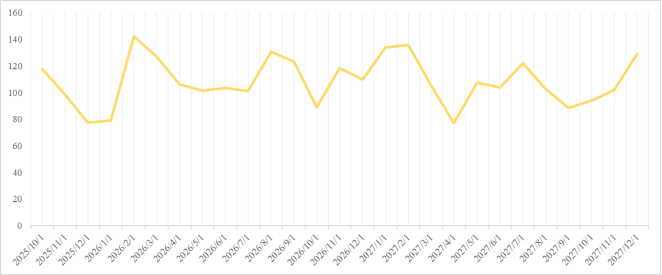
The quantitative projections reveal that the implementation of the EUDR will impose a significant, multi-phase impact on forest product exports from the Asia-Pacific region, characterized by distinct periods of initial contraction, subsequent adjustment, and eventual-though uneven-stabilization. As illustrated in
Figure 1, the aggregate export trend follows a trajectory that can be summarized as “short-term contraction, mid-term turbulence, and a long-term, divergent recovery”.
The initial phase, spanning the fourth quarter of 2025, is marked by a sharp, widespread decline in exports—a period of “immediate regulatory shock”. This downturn is largely attributable to profound compliance uncertainty and operational disruptions as the regulation takes effect. Market-wide hesitation, coupled with inevitable bottlenecks in establishing due diligence protocols, leads to a palpable constriction of trade flows, reflecting an industry-wide adaptation to the new compliance reality.
This is followed by a critical “extended adjustment and volatility” phase throughout 2026. During this period, export values for most countries are projected to exhibit pronounced instability, reflected in the wide confidence intervals of our forecasts. This sustained volatility is not merely a direct market reaction but a tangible manifestation of supply chains undergoing profound restructuring. Contributing factors include the time-intensive process for large enterprises to fully operationalize their due diligence systems, prolonged customs inspections under stricter traceability requirements, and the systematic filtering of non-compliant, high-risk products from EU-bound shipments. A notable inflection point occurs following the regulation's extension to SMEs in mid-2026, with aggregate exports dipping to a projected trough in the third quarter. This secondary decline underscores the disproportionate compliance burden on smaller operators, who often lack the technical and financial resources to adapt swiftly, resulting in the temporary or permanent exit of a significant segment of suppliers from the EU market.
By 2027, the market begins to converge toward a “new, albeit uneven, equilibrium”. A gradual rebound in aggregate volumes suggests that surviving market participants are progressively internalizing the new regulatory costs and operational requirements. However, this recovery is fundamentally divergent. More adaptable economies with robust regulatory frameworks, such as New Zealand and the Philippines, are projected to stabilize at revised export levels. In contrast, major manufacturing hubs like Vietnam and Malaysia continue to experience monthly fluctuations significantly above their historical norms, indicating that their complex, multi-tiered supply chains have not yet achieved full stability under the EUDR's stringent traceability demands.
Figure 1. Asia-Pacific Forest Product Exports Aggregate Trend.
5.2. Heterogeneity by Risk Classification
A comparative analysis of countries under different EUDR risk classifications provides compelling evidence of how the regulatory framework translates formal risk ratings into concrete trade implications. The forecast trajectories reveal a distinct divergence between standard-risk and low-risk jurisdictions, facing substantially more severe market challenges than their low-risk counterparts.
The export projections for these two Southeast Asian nations are characterized by pronounced volatility and significantly wider confidence intervals, reflecting deep-seated market uncertainty about their compliance capabilities and supply chain readiness. Particularly striking is Malaysia’s trajectory, which shows a precipitous decline in projected export value, with forecasts dipping below zero within the confidence interval during multiple months leading to March 2027. This pattern suggests a genuine risk of cyclical trade disruptions, likely stemming from systemic obstacles in meeting the EUDR’s stringent geolocation and deforestation-free verification requirements across complex supply chains.
In marked contrast, most low-risk economies such as Japan and Korea demonstrate considerably greater resilience. While experiencing initial regulatory shocks, their export values fluctuate within relatively narrow bands around historical averages, indicating robust shock-absorption capacity and smoother regulatory adaptation. This divergence underscores that the EUDR’s risk rating operates not merely as an administrative label but as a powerful market signal that directly influences trade partner confidence, financing conditions, and insurance costs. The regulatory classification thus appears to create a self-reinforcing cycle where higher-risk ratings amplify market uncertainty and potentially exacerbate adverse trade impacts, while lower-risk status provides stability and competitive advantage in the new regulatory environment.
This risk-based differentiation mechanism fundamentally reshapes competitive dynamics within the Asia-Pacific forest products trade, potentially altering long-established trade patterns and supply chain relationships in the region.
5.3. Heterogeneity by Export Scale
The implementation of the EUDR has elicited markedly divergent responses from Asia-Pacific exporters, with a clear dichotomy emerging between large-scale traders and their smaller counterparts. Major exporters such as Vietnam, Indonesia, and Malaysia, which support vast industrial clusters and complex multi-tiered supply chains, are projected to endure the most severe absolute fluctuations. Their monthly export values are forecast to swing by tens of millions of dollars, reflecting the profound systemic adjustments, widespread certification bottlenecks, and significant order delays faced by their extensive production networks.
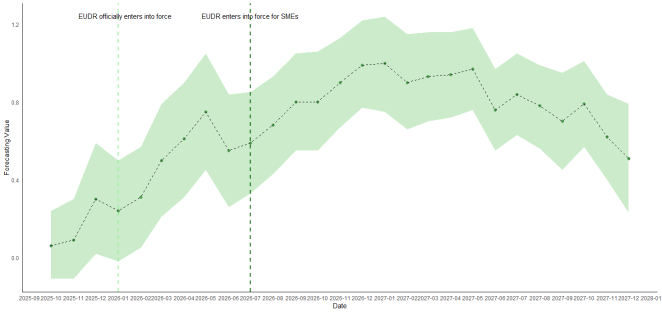
In contrast, the trajectories of smaller exporters reveal a different dynamic. The Philippines, in particular, presents a compelling case study of a potential “market substitution effect” in action. As illustrated in
Figure 2, after absorbing a brief initial shock, the country’s exports to the EU embark on a sustained and robust upward trajectory. Growing from a near-zero baseline in late 2025, its monthly export value is projected to plateau at approximately $1 million by late 2026-a level that substantially exceeds its historical performance. This counter-cyclial growth pattern strongly suggests that as dominant suppliers like Vietnam and Indonesia grapple with compliance-driven supply instability, smaller and more agile economies can capitalize on emerging gaps in the EU market. Provided they possess relatively transparent supply chains and can demonstrate regulatory compliance, these smaller players are positioned to respond swiftly to shifting European demand, thereby achieving notable market share gains.
Figure 2. Philippines’ Forest Product Exports Trend.
5.4. In-depth Analysis of Core Nations
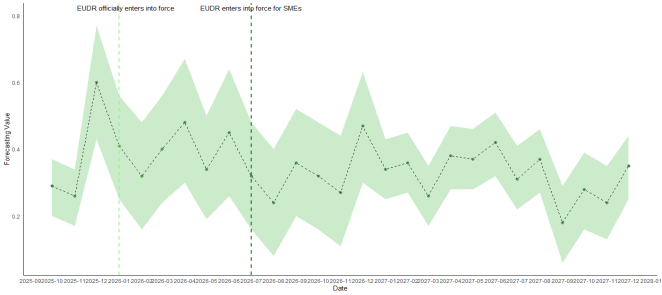
A comparative analysis of Japan and Malaysia, the two important timber suppliers in the region, uncovers divergent narratives of regulatory adaptation. Classified as low-risk, Japan’s exports demonstrate minimal structural break post-EUDR implementation, with forecasts remaining within narrow confidence intervals throughout the projection horizon (
Figure 3). Japan experiences only a modest, short-lived export decline following the EUDR implementation, with values quickly reverting to near-baseline levels and maintaining remarkable stability throughout the forecast period. This resilience reflects its advanced compliance infrastructure and supply chain coordination, enabling smooth adaptation across both large enterprises and SMEs. Japan’s stable, predictable export performance underscores how institutional readiness and low-risk status can effectively mitigate trade disruption, positioning it as a reliable anchor in the post-EUDR market landscape.
Figure 3. Japan’s Forest Product Exports Trend.
Figure 4. Malaysia’s Forest Product Exports Trend.
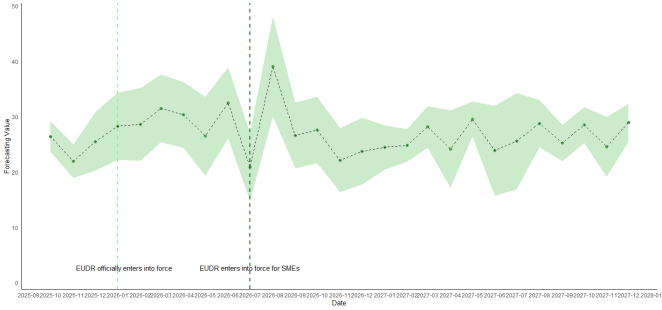
Based on the forecast trajectory, Malaysia’s adaptation to the EUDR reveals a pattern of stress that distinguishes it from other regional suppliers (see
Figure 4). As a standard-risk country, Malaysia's export projection demonstrates persistent instability throughout the forecast period, characterized by deep fluctuations and a possible failure to regain pre-regulation export levels. Following the EUDR’s implementation for large enterprises in late 2025, Malaysia’s exports undergo a severe and prolonged contraction, and its recovery momentum remains weak and fragmented. The extension of the regulation to SMEs in mid-2026 triggers further deterioration, pushing export values toward historical lows by early 2027. This continued decline reflects fundamental compliance challenges—particularly in verifying deforestation-free supply chains across its complex timber sectors. The persistently wide confidence intervals throughout the projection indicate substantial market uncertainty regarding Malaysia’s ability to meet EUDR’s stringent traceability requirements.
6. Conclusion
This study represents the first systematic attempt to quantitatively forecast the dynamic impacts of the EUDR on forest product exports from key Asia-Pacific economies. By developing a novel forecasting framework combining machine learning with econometric analysis, we simulate trade evolution across a 27-month implementation period. Our analysis reveals a complex regional adjustment pattern characterized by three distinct phases: initial contraction, mid-term turbulence, and an uneven recovery.
Four principal findings emerge from our research. First, the EUDR’s aggregate impact will be substantially disruptive, with the most severe effects occurring during initial implementation and a secondary shock wave emerging when the regulation extends to smaller enterprises. Second, the EU’s country-risk classification system functions as a powerful economic signal that directly translates into tangible trade consequences, exposing standard and high-risk nations to heightened volatility and constrained growth prospects. Third, the disruption affecting major suppliers creates measurable substitution effects, opening strategic opportunities for smaller, well-prepared low-risk countries to gain market share. Finally, even technically compliant major exporters like Vietnam face significant supply chain stress tests, experiencing whiplash effects from inventory fluctuations that substantially destabilize trade flows.
These empirical findings yield several critical policy implications. For Asia-Pacific governments, our results highlight the urgent need for targeted support mechanisms for small and medium enterprises, particularly through enhanced traceability infrastructure, capacity-building programs, and financial assistance for certification processes. For standard-risk nations including Indonesia and Malaysia, pursuing dual strategies of improving domestic forest governance to achieve lower risk ratings while simultaneously diversifying export markets appears essential for mitigating long-term economic damage. For industry stakeholders, our forecasts underscore the necessity of investing in supply chain transparency, adopting geolocation technologies, and developing strategic market diversification to build resilience against future regulatory shocks.
Abbreviations
EUDR | European Union Deforestation Regulation |
EU | European Union |
LASSO | Least Absolute Shrinkage and Selection Operator |
OLS | Ordinary Least Squares |
EUTR | European Union Timber Regulation |
SMEs | Small and Medium Enterprises |
CGE | Computable General Equilibrium |
HS code | Harmonized System Codes |
CPI | Consumer Price Index |
HICP | Harmonized Index of Consumer Prices |
EUDR | European Union Deforestation Regulation |
Conflicts of Interest
The authors declare no conflicts of interest.
References
| [1] |
Yin, Z. H., Li, J. Q., Tian, H., et al. (2011). Impacts of EU Timber Regulation on international trade of forest products and China's countermeasures. Research of Agricultural Modernization, 32(5), 537-541.
https://doi.org/10.3969/j.issn.1000-0275.2011.05.006
|
| [2] |
Hou, X. Y.; Yin, Z. H.; Qiu, L. Y.; et al. Study on the challenges of EU Timber Regulation to China's wood forest products trade and countermeasures. Forestry Economics 2013, 37, 54-57.
https://doi.org/10.13843/j.cnki.lyjj.2013.12.014
|
| [3] |
Hou, F. M.; Zhuang, J. Q. Impact analysis of EU Timber Regulation on China's wooden furniture exports to the EU. Journal of Xi’an University of Finance and Economics 2015, 28, 99-105.
https://doi.org/10.3969/j.issn.1672-2817.2015.04.016
|
| [4] |
Brack, D. (2017). The European Union’s Timber Regulation: Is it working? Chatham House URL:
https://www.chathamhouse.org/2017/06/european-unions-timber-regulation-it-working
|
| [5] |
Mao, X. Y.; Chen, Y.; Jiang, H. F. EU's Regulation on deforestation-free products and its impacts and countermeasures. World Forestry Research 2022, 35, 93-98.
https://doi.org/10.13348/j.cnki.sjlyyj.2022.0049.y
|
| [6] |
Simonnet, A. The impact of the European Deforestation-Free Regulation on trade relations with Southeast Asia. Regulation (EU) 2023, 1115.
https://doi.org/10.2478/vjls-2024-0017
|
| [7] |
Permatasari, A. P.; Fauziyah, D.; Naufal, F.; Afian, S.; Nisa, S.; Fetra, T.; Hadad, N. Strengthening Indonesia’s readiness to navigate the European Union Deforestation-Free regulation through improved governance and inclusive partnership. 2024. URL:
https://madaniberkelanjutan.id/wp-content/uploads/2024/03/Madani-Update-EUDDR-ENG_Final.pdf
|
| [8] |
Jopke, P., & Schoneveld, G. C. (2022). The European Union Deforestation Regulation: A primer for policymakers in producer countries. CIFOR. URL:
https://www.cifor-icraf.org/publications/pdf/working-papers/2022-08-The-European-Union-Deforestation-Regulation.pdf
|
| [9] |
Roldan Muradian, Raras Cahyafitri, Tomaso Ferrando, Carolina Grottera, Luiz Jardim-Wanderley, Torsten Krause, Nanang I. Kurniawan, Lasse Loft, Tadzkia Nurshafira, Debie Prabawati-Suwito, Diaz Prasongko, Paula A. Sanchez-Garcia, Barbara Schröter, Diana Vela-Almeida. Will the EU deforestation-free products regulation (EUDR) reduce tropical forest loss? Insights from three producer countries. Ecological Economics. 225(227): 108389.
https://doi.org/10.1016/j.ecolecon.2024.108389
|
| [10] |
Anderson, J. E. A theoretical foundation for the gravity equation. Am. Econ. Rev. 1979, 69, 106-116.
http://www.jstor.org/stable/1802501
|
| [11] |
Larson, J.; Baker, J.; Latta, G.; Ohrel, S.; Wade, C. Modeling International Trade of Forest Products: Application of PPML to a Gravity Model of Trade. Forest Products Journal 2018, 68, 303-316.
https://doi.org/10.13073/fpj-d-17-00057
|
| [12] |
Nasrullah, M.; Chang, L.; Khan, K.; Rizwanullah, M.; Zulfiqar, F.; Ishfaq, M. Determinants of forest product group trade by gravity model approach: A case study of China. Forest Policy and Economics 2020, 113, 102117.
https://doi.org/10.1016/j.forpol.2020.102117
|
| [13] |
Xu, Y. S.; Hou, F. M.; Shi, Z. H.; et al. Impact of EU Deforestation-free Regulation on China's forest products trade: An analysis based on GTAP model. World Forestry Research 2025, 38, 94-101.
https://doi.org/10.13348/j.cnki.sjlyyj.2025.0025.y
|
| [14] |
Hu, Y. H.; Meng, Q.; Xia, J.; Chen, N. Impact of EU Deforestation-free Regulation on China's forest products trade. Working paper 2025.
|
| [15] |
Wang, F. T.; Liu, S. T.; Cheng, B. D.; Jiang, Q. E.; Tian, Y.; Xiong, L. C. How Can Intra Industry Trade of Forest Products be Promoted? An Empirical Analysis from China. Forests 2019, 10, 882.
https://doi.org/10.3390/f10100882
|
| [16] |
Tibshirani, R. Regression shrinkage and selection via the LASSO. Journal of the Royal Statistical Society: Series B (Methodological) 1996, 58, 267-288.
https://doi.org/10.1111/j.2517-6161.1996.tb02080.x
|
| [17] |
Medeiros, M. C.; Vasconcelos, G. F.; Veiga, Á.; Zilberman, E. Forecasting inflation in a data-rich environment: the benefits of machine learning methods. Journal of Business & Economic Statistics 2021, 39, 98-119. 23.
https://doi.org/10.2139/ssrn.3155480
|
Cite This Article
-
APA Style
Hu, Y., Meng, Q., Chen, N., Yuan, M., Xia, J. (2025). Forecasting the Impact of the EU Deforestation Regulation (EUDR) on Asia-Pacific Forest Product Trade. American Journal of Environmental and Resource Economics, 10(4), 149-160. https://doi.org/10.11648/j.ajere.20251004.14
Copy
|
Download
ACS Style
Hu, Y.; Meng, Q.; Chen, N.; Yuan, M.; Xia, J. Forecasting the Impact of the EU Deforestation Regulation (EUDR) on Asia-Pacific Forest Product Trade. Am. J. Environ. Resour. Econ. 2025, 10(4), 149-160. doi: 10.11648/j.ajere.20251004.14
Copy
|
Download
AMA Style
Hu Y, Meng Q, Chen N, Yuan M, Xia J. Forecasting the Impact of the EU Deforestation Regulation (EUDR) on Asia-Pacific Forest Product Trade. Am J Environ Resour Econ. 2025;10(4):149-160. doi: 10.11648/j.ajere.20251004.14
Copy
|
Download
-
@article{10.11648/j.ajere.20251004.14,
author = {Yuanhui Hu and Qian Meng and Neng Chen and Mei Yuan and Jie Xia},
title = {Forecasting the Impact of the EU Deforestation Regulation (EUDR) on Asia-Pacific Forest Product Trade},
journal = {American Journal of Environmental and Resource Economics},
volume = {10},
number = {4},
pages = {149-160},
doi = {10.11648/j.ajere.20251004.14},
url = {https://doi.org/10.11648/j.ajere.20251004.14},
eprint = {https://article.sciencepublishinggroup.com/pdf/10.11648.j.ajere.20251004.14},
abstract = {This study provides a comprehensive, quantitative forecast of the dynamic impact of the European Union Deforestation Regulation (EUDR) on forest product exports from nine major Asia-Pacific economies to the EU market. To address the complexity of this policy shock, we develop a novel two-stage forecasting framework that integrates LASSO regression for high-dimensional variable selection with OLS modeling. This approach generates dynamic monthly projections from October 2025 to December 2027, simulating the policy’s effect by combining a historical proxy from the European Union Timber Regulation (EUTR) with a calibrated “intensity multiplier” based on the EUDR country-risk classification. Our projections reveal a distinct multi-phase adjustment process across the region: an immediate, sharp contraction in Q4 2025, followed by a period of significant volatility and supply chain disruption throughout 2026, and an uneven recovery in 2027. The findings underscore substantial heterogeneity in impacts driven by the EUDR risk-based framework. Standard-risk countries, such as Indonesia and Malaysia, are projected to face severe volatility and suppressed growth trajectories, with Malaysia’s exports showing particular vulnerability. In contrast, some smaller, low-risk nations like the Philippines may capitalize on a substitution effect, gaining market share as larger suppliers struggle with compliance. The study concludes that the EUDR acts as a powerful disruptive force, reshaping competitive dynamics and necessitating urgent policy responses, including enhanced traceability infrastructure and strategic market diversification, for Asia-Pacific exporters.},
year = {2025}
}
Copy
|
Download
-
TY - JOUR
T1 - Forecasting the Impact of the EU Deforestation Regulation (EUDR) on Asia-Pacific Forest Product Trade
AU - Yuanhui Hu
AU - Qian Meng
AU - Neng Chen
AU - Mei Yuan
AU - Jie Xia
Y1 - 2025/12/09
PY - 2025
N1 - https://doi.org/10.11648/j.ajere.20251004.14
DO - 10.11648/j.ajere.20251004.14
T2 - American Journal of Environmental and Resource Economics
JF - American Journal of Environmental and Resource Economics
JO - American Journal of Environmental and Resource Economics
SP - 149
EP - 160
PB - Science Publishing Group
SN - 2578-787X
UR - https://doi.org/10.11648/j.ajere.20251004.14
AB - This study provides a comprehensive, quantitative forecast of the dynamic impact of the European Union Deforestation Regulation (EUDR) on forest product exports from nine major Asia-Pacific economies to the EU market. To address the complexity of this policy shock, we develop a novel two-stage forecasting framework that integrates LASSO regression for high-dimensional variable selection with OLS modeling. This approach generates dynamic monthly projections from October 2025 to December 2027, simulating the policy’s effect by combining a historical proxy from the European Union Timber Regulation (EUTR) with a calibrated “intensity multiplier” based on the EUDR country-risk classification. Our projections reveal a distinct multi-phase adjustment process across the region: an immediate, sharp contraction in Q4 2025, followed by a period of significant volatility and supply chain disruption throughout 2026, and an uneven recovery in 2027. The findings underscore substantial heterogeneity in impacts driven by the EUDR risk-based framework. Standard-risk countries, such as Indonesia and Malaysia, are projected to face severe volatility and suppressed growth trajectories, with Malaysia’s exports showing particular vulnerability. In contrast, some smaller, low-risk nations like the Philippines may capitalize on a substitution effect, gaining market share as larger suppliers struggle with compliance. The study concludes that the EUDR acts as a powerful disruptive force, reshaping competitive dynamics and necessitating urgent policy responses, including enhanced traceability infrastructure and strategic market diversification, for Asia-Pacific exporters.
VL - 10
IS - 4
ER -
Copy
|
Download